
When starting a commercial construction project, the first big step isn’t breaking ground-it’s choosing how the project will be set up and managed. The main difference between design-build and traditional contracts is how responsibilities are organized and in what order the work happens.
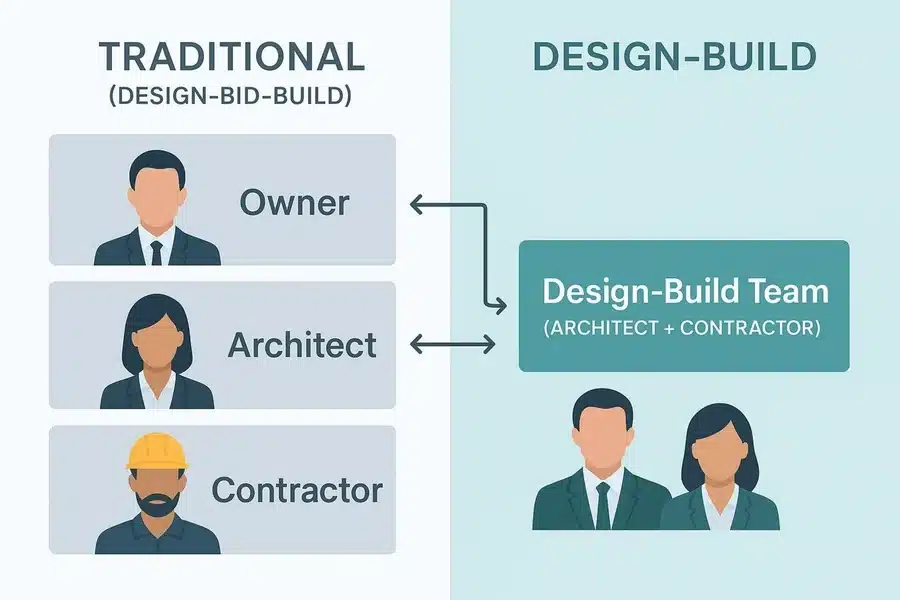
In a traditional contract (Design-Bid-Build), the owner signs two separate agreements: one for design and one for construction. Work moves in a straight line, one phase after another. With design-build, design and construction are combined in a single contract with one team, so phases can overlap and the project is more coordinated from day one.
This choice matters a lot because it affects your schedule, final cost, and how much pressure you carry as the owner. For example, specialized work like https://novaconstructionservices.com/services/facade-restorations/local-law-11-repairs/ often needs strict technical accuracy and careful code compliance.
In these cases, the contract method can strongly affect how smoothly safety rules are met and how well the building’s structure and appearance are protected. As the industry changes, knowing these differences is key to getting a successful result.
Design-Build vs. Traditional Contracts: What Sets Them Apart in Commercial Construction?
Key Characteristics of Traditional Construction Contracts
The traditional approach, known as Design-Bid-Build (DBB), has been common for many years. Its key feature is a clear split between design and construction. The owner first hires an architect or design firm to create full drawings and specifications.
After the plans are complete, the project goes out to bid, and several general contractors compete for the job, usually based on the lowest price. Each phase finishes before the next one starts, creating a strict step-by-step path.
Because the designer and builder are separate, the owner has strong control over the design before any contractor is chosen. But this also means the owner must act as the go-between for two parties who may never have worked together before.
If a design issue shows up during construction, the owner often ends up stuck in the middle, trying to sort out whether the problem came from the drawings or how the work was done.
Core Features of Design-Build Contracts
Design-build (DB) is a more modern, streamlined setup that is becoming increasingly popular. Here, the owner signs a single contract with a “design-builder”-either one company that includes both designers and builders or a partnership between the two. This single point of responsibility is the key feature.
From early concept through final punch list, the owner deals with one main team, which makes communication simpler and cuts down on the blame game that often happens with traditional methods.
Teamwork is at the center of design-build. The people who will build the project are involved while the drawings are still being developed, so they can quickly comment on what is practical to build and what may be risky or costly. This close coordination often leads to smarter solutions and a smoother flow of work-construction might start on the structure while details for interior areas are still being finalized.
How Do the Processes Differ Between Design-Build and Traditional Contracts?
Project Delivery Workflow: Sequential vs. Integrated
In a traditional setup, the workflow follows a straight path: Design → Bid → Build. This is simple to follow but can be slow. Each phase is a gate you must fully pass through before moving on. You can’t start bidding until the design is complete, and you can’t start building until bidding is finished. This “finish one step before the next” system helps everyone know exactly what will be built, but if one phase is delayed, there is little chance to make up lost time.
Design-build uses a more combined approach. It’s often called a “fast-track” method because design and construction overlap. The team might pour foundations while decisions about interior layouts and finishes are still being made. This overlap lets design-build projects move much faster than traditional ones, which appeals to developers who need a building open and producing income as quickly as possible.
Roles and Responsibilities of Key Stakeholders
With a traditional contract, the owner has to be very involved. They hold separate contracts with the architect and the general contractor and must coordinate both. If the architect designs something that the contractor says cannot be built within the budget, the owner has to lead the discussion and push for a fix. This role takes time and requires a basic understanding of construction to handle well.
Under design-build, the owner’s role shifts from daily manager to guiding partner. The design-build team takes on the coordination work. If there is a conflict between the drawings and field conditions, the design-build group works it out internally. The owner shares the project goals, budget, and performance needs, and the team works toward those targets. This lets the owner stay focused on their main business instead of daily construction details.
Team Selection and Early Collaboration
In traditional contracts, selection often focuses on price. Because the design is already finished, owners usually pick the contractor who can build that exact design for the lowest cost. While this may save money at the start, it does not always reflect how well the team works together or how good they are at solving problems creatively. There is little early collaboration because the contractor joins after the design is complete.
In design-build, owners often choose the team based on experience, qualifications, and overall value instead of just the lowest number. Owners look for firms with a record of working well as a group. Early teamwork is a big advantage here; by bringing the builder in before construction starts, the team can spot supply issues, code concerns, or structural challenges long before they become costly. This early planning supports a shared sense of responsibility and common goals.
Timeline, Cost, and Risk: Comparing Project Outcomes
Project Timelines and Speed to Completion
Time has a direct impact on cost in commercial work, and this is where design-build often stands out. Because design and construction run side by side, projects usually finish faster than traditional step-by-step builds. There is no long bidding period where nothing happens while contractors prepare estimates. The team keeps moving from one milestone to the next with fewer pauses.
Traditional contracts often move more slowly. While careful planning is helpful on complex projects, the step-by-step process means any delay in design slows the whole job. If bids come back higher than expected, the drawings may need to be revised and rebid, adding weeks or months to the schedule.
Cost Certainty and Budget Predictability
Unexpected “change orders” are one of the biggest worries for owners. In traditional contracts, these are common because the builder had no input during design. The contractor may find that a called-for material is back-ordered or that a detail cannot be built as drawn, leading to extra cost that the owner must pay.
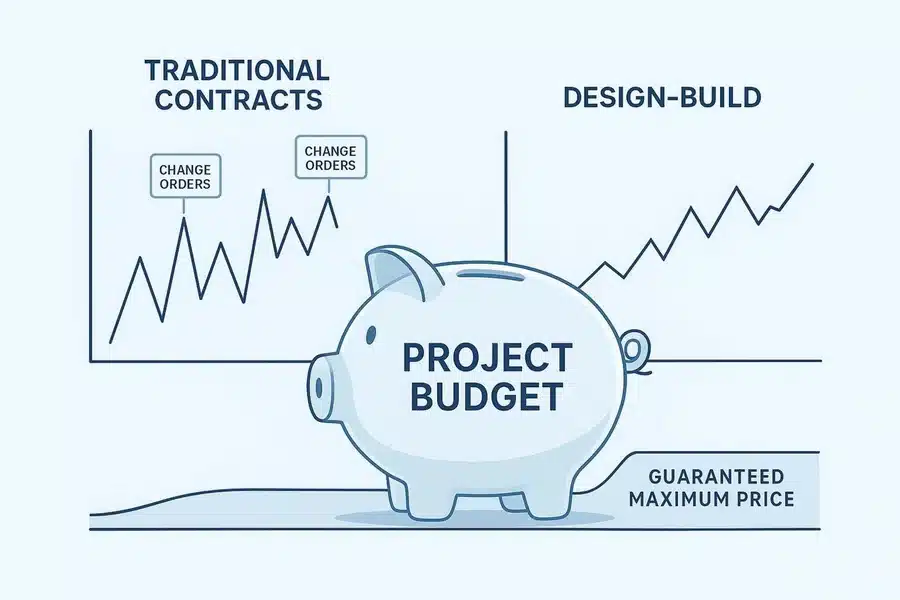
Design-build usually offers better cost control. Because the full team works together from the start, they can give more accurate pricing earlier. Many design-build deals use a “Guaranteed Maximum Price” (GMP), where the contractor agrees that costs will not go beyond a set limit, unless the scope changes. Since the builder helped shape the design, there are fewer excuses for surprise costs, fewer change orders, and a more stable budget picture for the owner.
Risk Allocation and Management
Risk is a major concern on any construction project, and how it is shared makes a big difference. Under a traditional contract, the owner carries much of the risk for the quality of the plans. If the drawings contain an error, the owner often has to pay the contractor to fix the problem. This can create a tense relationship where the architect and contractor blame each other to avoid paying for mistakes.
Professional restoration and repair specialists, such as https://novaconstructionservices.com/, often emphasize that clear communication and early risk assessment are vital to preventing these structural and financial headaches.
Design-build moves much of that risk to the design-build team. Since one group is responsible for both design and construction, they cannot pass blame back and forth. If there is a gap between what was drawn and what can be built, the design-builder is responsible for fixing it. This clearer accountability often cuts down on legal disputes and keeps everyone focused on solutions instead of arguments.
Collaboration, Communication, and Quality Control
How Each Method Impacts Owner Involvement
If you enjoy being involved in every detail-reviewing each fixture, finish, and structural choice-traditional delivery may feel more comfortable. You work closely with the architect, who acts as your representative and checks that the contractor is following the design. You remain the final decision-maker on many issues.
Design-build expects a different style of involvement. You spend more time early on setting clear goals, budget limits, and performance targets, then give the team room to carry them out. Owners who prefer a “hands-off” or “turnkey” experience often like this approach. You still handle the key approvals but are not pulled into every disagreement between designer and builder.
Influence on Design Innovation and Flexibility
It might seem that keeping design and construction separate leads to more creative freedom-and sometimes it does. In a traditional setup, the architect can explore bold ideas without immediate pressure from the contractor about cost or constructability. This can lead to very unique and striking buildings, but they may be more expensive and harder to build.
Design-build supports a more practical kind of creativity. When designers and builders work as one team, they can find smart ways to reach a high-end look using simpler details, better materials, or faster methods. This joint problem-solving often results in buildings that look good, work well, and handle energy use and maintenance more efficiently, because performance issues are discussed early instead of late.
Quality Assurance Throughout the Build
In a traditional contract, quality control relies on checks and balances. Because the architect is independent from the contractor, they can review the work on site and compare it to the plans. Many owners like having this third-party oversight, as it helps prevent shortcuts and keeps the contractor aligned with the original design.
With design-build, quality control is handled inside one organization. Some people worry that a single team might cut quality to save time or money, but in practice many design-build firms work hard to avoid this. Their name, reputation, and profits depend on the final result. Most established design-build companies use strict internal review systems, knowing that any mistake they make is their responsibility to fix.
Advantages and Challenges of Design-Build Contracts
Benefits of Choosing Design-Build for Commercial Projects
The main benefit of design-build is efficiency. By combining design and construction under one contract and limiting the formal bidding phase, projects often move faster and sometimes cost less. Clear communication within a single team usually leads to fewer errors, fewer disputes, and a smoother project path. For growing businesses like retailers, logistics centers, or medical facilities, this speed can be a major advantage.
Beyond speed, the team-based setup often gives the owner better overall value. The group can use “value engineering” throughout the project, finding cost savings that do not reduce quality. Having one primary contact also makes life easier for the owner, cutting down on paperwork, meetings, and coordination work so they can pay more attention to running their core business.
Potential Drawbacks and Limitations
Design-build does have downsides. Many owners worry about giving up some direct control. Once design and construction are bundled and work has started, large design changes can be harder to make without affecting both schedule and cost. Also, because there is no final round of bidding on a completed design, some owners fear they might miss the very lowest construction price.
Another concern is the loss of an independent voice. In traditional contracts, the architect works directly for you and can push back on the contractor if needed. In design-build, the architect is part of the same overall team as the builder. While this helps cooperation, it means you must pick a firm you trust. If you choose poorly, the impact can be severe, since one group controls both design and construction instead of just one side.
Advantages and Challenges of Traditional Construction Contracts
Strengths of the Traditional Approach
The Design-Bid-Build method provides comfort through its clear steps and open pricing. You know exactly what is included because the design is fully reviewed and approved before contractors submit prices. Competitive bidding helps confirm that the cost reflects current market rates, which many public agencies and large organizations require by policy.
Separating architect and contractor also creates a natural oversight system. The architect’s role includes making sure the builder follows the agreed design and uses acceptable materials. For projects with strict architectural needs or detailed historic preservation, this careful, phase-by-phase process supports close attention to every feature and finish.
Challenges and Disadvantages for Owners
The traditional approach often carries more conflict risk. Because the architect and contractor have separate contracts and different priorities (the architect emphasizes design quality, the contractor emphasizes budget and schedule), disagreements can be common. The owner usually has to step in and sort these out, which takes time and money.
The method is also usually slower. Any delay in design, approvals, or bidding can quickly push back the completion date. Owners may also face “sticker shock” if bids come in higher than the architect’s early estimates. At that point, parts of the design may need to be cut or changed and then rebid, which can be frustrating and can delay opening the building. In fast-moving markets, such delays can mean missed business chances and higher finance costs.
When Should You Choose Design-Build or Traditional Contracts?
Factors to Consider for Project Decision-Making
Your choice usually depends on what matters most to you: speed, cost control, or design control. If your main goal is to open the building quickly and reduce your own workload, design-build is often the better fit. It offers one of the fastest routes from idea to opening and can give strong price clarity through its integrated structure.
If your project has a very unique or complex design and you want maximum creative control, and schedule is less urgent, the traditional method may serve you better. It is also common on public projects where rules require low-bid selection. You should also think about your own in-house skills; if you don’t have an experienced construction manager on staff, the simpler communication path of design-build can be a major help.
Project Types That Benefit from Each Contract Method
Design-build works especially well for repeatable or standard commercial projects, such as offices, distribution centers, and retail spaces, where speed and efficiency are key. It also suits projects with tight deadlines or those built in stages. The ability to adjust while work is underway makes it a strong choice for renovations, where hidden conditions often appear once walls and ceilings are opened.
Traditional contracts are often chosen for highly specialized buildings like museums, luxury hotels, or complex government facilities. These jobs often need a long and careful design phase before a contractor is selected. They also benefit from the independent oversight that a separate architect provides, helping confirm that detailed design elements are carried out exactly as planned.
Questions to Ask Before Deciding
Before you commit, ask yourself some key questions. How much time can I realistically put into managing this project? If your answer is “very little,” design-build may be the better option. How comfortable am I with possible budget changes? If you need a firm number early, a design-build contract with a GMP can offer more comfort. Do I have a specific architect I must use, or am I open to choosing a combined team?
You should also look at your local market. Are there strong design-build firms nearby with experience on projects similar to yours? Check their history of completed work and ask for references from owners who have used both approaches. Seeing how each method played out for others in your area and industry can help you choose a path you’ll feel confident about long after the ribbon-cutting.
Case Study: Design-Build vs. Traditional Contracts in Action
Commercial Project Scenario and Outcomes
Imagine a mid-sized tech company that needs a new 50,000-square-foot headquarters. Under a traditional Design-Bid-Build model, the company hires an architect who spends six months designing a striking “glass box” office. When the project goes to bid, the lowest price is 20% higher than the company’s budget.
The next three months are spent changing materials and simplifying details to cut costs, which delays the move-in date by about half a year and strains the relationship between the leadership team and the architect.
Now consider the same company using a design-build partner. In the first week, the builder and architect meet with the leadership team. The builder explains that the full glass design will be costly to keep cool and offers a high-performance facade system that looks similar but costs less and has better energy performance. Because the builder is involved from the start, they place orders early for key electrical and mechanical components while the interior layout is still being fine-tuned.
The result: the project finishes two months early and on budget, allowing the company to move in sooner and use the new space to attract talent and grow their business.
Trends Shaping the Future of Commercial Construction Contracts
Industry Innovations and Shifts Toward Design-Build
The construction market is changing quickly. By early 2026, design-build has continued to grow and now accounts for nearly 47% of commercial projects. This shift reflects pressure for quicker delivery and reduced waste. Tools like Building Information Modeling (BIM) make the team-based style of design-build even more effective by letting the group build and test the project virtually before field work starts.

Another growing approach is “Integrated Project Delivery” (IPD), which pushes collaboration further by tying the owner, architect, and contractor together financially. All parties share in both gains and losses, which encourages them to work as one unit instead of separate sides. As material prices shift and labor remains tight, the industry is moving toward these more integrated models.
Environmental goals are also shaping how contracts are written. Modern commercial projects must deal with strict energy codes and carbon reduction targets, which are easier to handle when design and construction teams cooperate closely.
The future of construction points toward these more integrated systems, where new digital tools and strong human collaboration combine to deliver buildings that are faster to build, more efficient to operate, and better prepared for changing demands.
Whether through modular construction, advanced scheduling tools, or AI-supported supply chain planning, the aim stays the same: giving owners strong value while lowering the natural risks that come with building.


